
The Family Computer Disk System (also called the Famicom Disk System) is an accessory for the Family Computer. It allowed the Family Computer to play certain games on a proprietary floppy disk format called "Disk Cards" rather than ROM cartridges. Disk Cards had the advantages of being cheaper and allowing for higher data capacity than cartridges at the time. Besides that, the disks were rewritable, making saving easier. Nintendo sought to make Disk Cards a permanent standard for all of its future games at that point, though this plan was abandoned a few years later, due to various issues. Sharp Corporation, a Japanese electronics manufacturer, created the Twin Famicom, a Family Computer combined with the Disk System into one piece of hardware, but it was also released only in Japan.
Issues
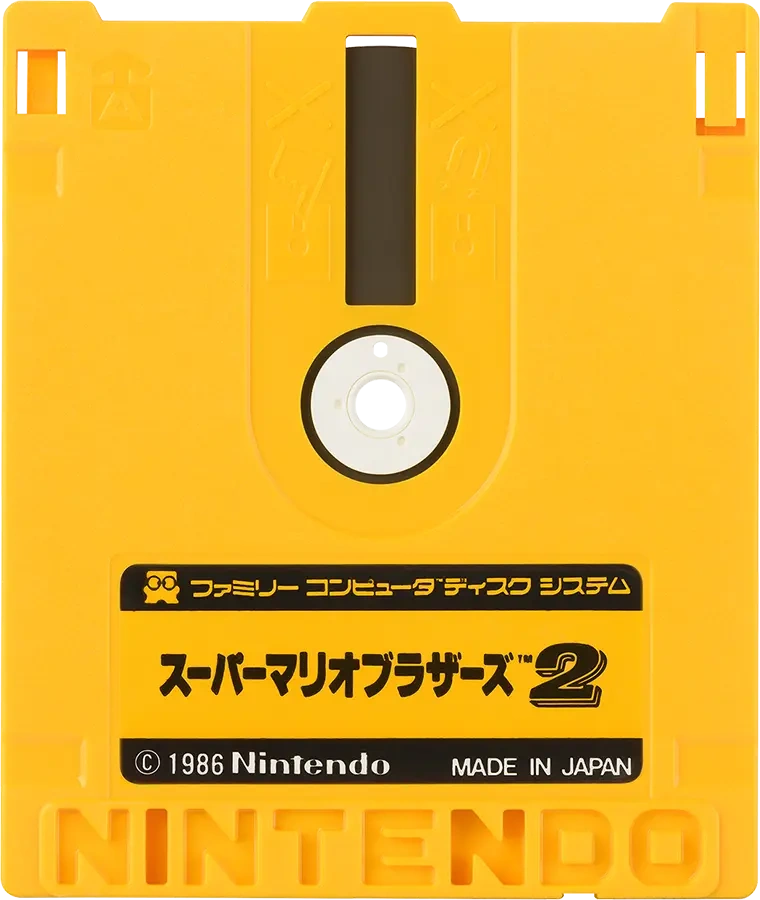
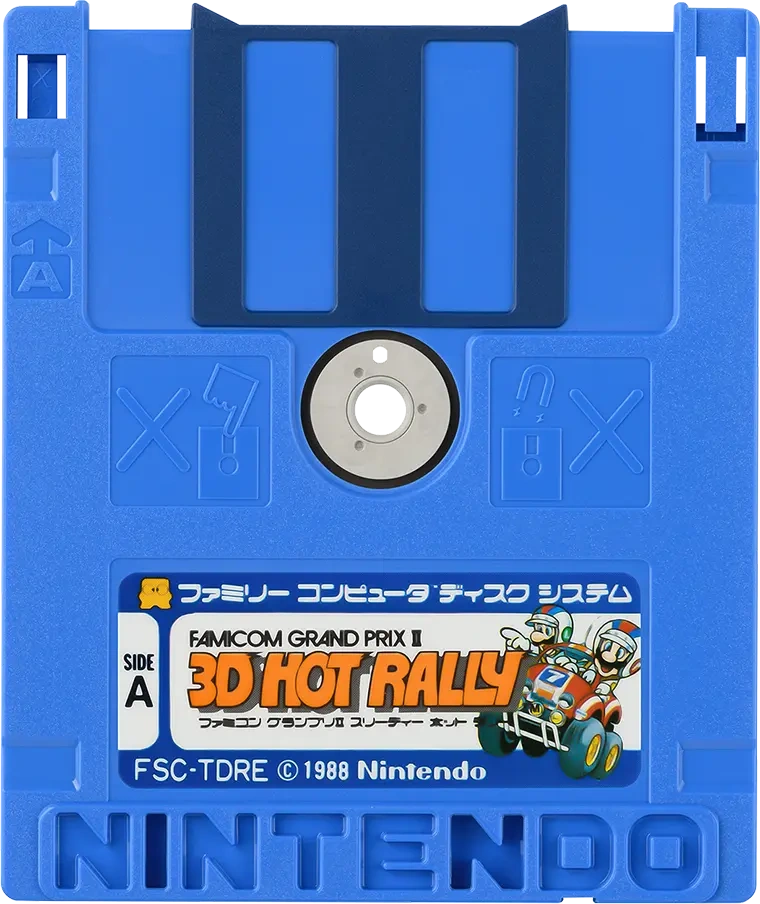
The main reason as to why the Family Computer Disk System was not released outside Japan and why it eventually lost developer support altogether is believed to be due to a lack of success caused by various issues with the system:[4][5]
- The games were significantly easier to pirate; the way the Disk System recognized pirated games was by checking to see if the "I" and the third "N" in the embossed "NINTENDO" logo at the bottom of a Disk Card was present, via fitting a raised version of the same logo into the embossing. The intention behind this was for Nintendo to be able to directly counter production of unauthorized Disk Drive games by suing their manufacturers for trademark infringement, assuming that pirates would copy the full logo outright. However, it was easy for pirates to bypass this check without directly copying Nintendo's logo by creating alternate off-brand logos with the "I" and third "N" intact (i.e. "NINFENDO" or "NINIENDO") or by simply embossing blank spaces that occupied the locations of the necessary letters. Furthermore, the fact that Disk Cards were simply modified versions of Quick Disks (a brand of floppy disk easily purchasable in stores in the late 1980's) meant that unauthorized Disk Cards could be easily manufactured by attaching a copy check-compatible piece of plastic to the bottom of a Quick Disk.
- The games were easier to damage; Disk Cards, being a form of magnetic media, were sensitive to magnetic wavelengths, and unlike regular 3.5-inch floppy disks, most Disk Cards did not include a shutter to protect the window that exposed the magnetic disk inside; shutters were only included on blue competition cards and gold prize cards. The lack of a shutter meant that the disk could get scratched, dirty, or even grow mold in severe cases.
- The system itself was more fragile than the base Famicom, due to the large number of moving parts needed for the disk drive; in particular, the rubber belt that the system used was prone to wearing down much faster than that of a standard floppy disk drive.
- Any games that made use of the supplementary audio channel provided by the Disk System's 2C33 chip would have to be drastically altered during localization for international markets to conform to the audio capabilities of the standalone Famicom, as no devices were released for the Nintendo Entertainment System that supported 2C33 chip audio.
- The games had lengthy loading times at various points (often when swapping sides, or when entering particularly data-heavy areas). This is because magnetic disk drives have to physically seek out where data is located on the disk in order to load it into RAM. By comparison, cartridges are able to load near-instantaneously due to all the data being stored in a single location, that being the on-board ROM chip.
- Most games would have to be split across both sides of the Disk Card due to the small size of the magnetic disks; typically, the first and final portions of the game would be stored on Side A, while the rest would be stored on Side B. Consequently, whenever the player progressed to a certain point in a game, they would be required to eject and flip the Disk Card before reinserting it.
- The jewel cases that contained the games were smaller than cartridge boxes, and were therefore easier to overlook in stores or lose in homes. The cases were also required to fully protect the Disk Card, whereas cartridges could be stored, standalone, on shelves.
- The technological superiority of the Disk Card format was short-lived, with higher-capacity cartridges becoming cheaper to produce just a few years later. Combined with the higher rate of piracy that Disk Cards suffered from, this deprived the format of the practicality that served as its primary selling point for developers.
The piracy issue was an especially big problem for Nintendo, and is believed to be the source of their stringent policies regarding copyright protection. It is also widely believed that the Disk System's high piracy rate is what convinced Nintendo to use cartridges for the Nintendo 64 rather than the technologically superior optical discs seen in their rivals, the Sega Saturn and Sony PlayStation.
In 1986, Nintendo sought to counter Disk System piracy by installing special Disk Writer kiosks that would allow consumers to download games onto Disk Cards for ¥500 as opposed to the retail price of ¥2,600; some Disk System games were even exclusive to these kiosks. The service was very popular, remaining in place until the Family Computer line's discontinuation in 2003, 9 years after the discontinuation of the Disk System itself. Excluding prize disks, FDS games were available through retail, Disk Writer, or both. Mario Bros. Returns and the FDS ports for Donkey Kong, Donkey Kong Jr., Pinball, and Wrecking Crew could be purchased only through the Disk Writer. The former was priced at ¥400 because of its promotional nature, making it the cheapest FDS game. I am a teacher: Super Mario Sweater was a retail-only game, but it was sold in handicraft stores. All Night Nippon: Super Mario Bros. was sold through a mail order lottery system and at Nippon Broadcasting System's building on a single day. The Disk Writer was also capable of updating software for any game that needed it (thus acting as an early precursor to modern internet-based software patching), the sole exception being Golf: Japan Course, which required mailing the disk to Nintendo.
Games
Differences from cartridge versions
For the most part, FDS games are identical to their Famicom or NES cartridge versions. Here are some differences found in Super Mario games:[6]
- Donkey Kong: When Mario scores, the points are in orange instead of white.
- Super Mario Bros.: The Minus World is completely different. Beating it counts as beating the game, which starts Hard Mode.
- Wrecking Crew: It is possible to save custom levels without the Family BASIC's Data Recorder accessory.
Blue and gold disks
Six games received blue disks, five were made by Nintendo and were compatible with Disk Fax, four of which are Super Mario games. All compatible blue disk games were subject of tournaments with scores submitted through the Disk Fax, a device that could send contestants' data and high scores to Nintendo. The tournament began as soon as the blue disks were released.
| Tournament number | Game | Date | Prizes |
|---|---|---|---|
| 1 | Golf: Japan Course | February 21 to May 10, 1987 (original deadline was April 30) | Prizes included two different gold disk versions of the game, each with a harder course. The top 100 players received the Champions' Course and gold plaques. 5,000 others received the Professional Course. |
| 2 | Golf: U.S. Course | June 14 to August 31, 1987 | The top 100 players received trophies. 10,000 received a gold Famicom cartridge of Punch-Out!! and 1,000 got Golf: Prize Card, a harder gold disk version. |
| 3 | Famicom Grand Prix: F1 Race | October 30 to December 15, 1987 | The top 100 players of each of the four difficulty levels received trophies. 10,000 received a special edition Game & Watch of Super Mario Bros. |
| 5 | Famicom Grand Prix II: 3D Hot Rally | April 14 to May 31, 1988 | The top 100 players of each of the three car types received trophies. 10,000 received stationery sets. |
The three gold disks and Wakusei Aton Gaiden are the only FDS games that were never available through retail.[7] No gold or blue disk games have a cartridge equivalent and were distributed only in Japan.
Gallery


.png "The Lost Levels front cover (JP).png (295 KB)")

System gallery

Trivia
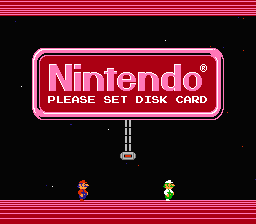
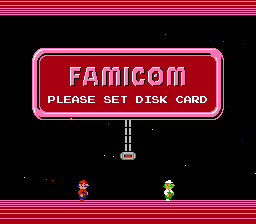
- Mario and Luigi also appear in the Disk System's BIOS, seen when the Disk System is started. The BIOS also makes a cameo appearance in Paper Mario: The Thousand-Year Door, on Sir Grodus's computer. His computer accepts a Data Disk that looks like a Disk Card.[8]
- The system mascot, Diskun, made a cameo as a toy in Booster's Tower in Super Mario RPG: Legend of the Seven Stars. This was made more apparent in the game's remake for the Nintendo Switch due to enhanced graphics.
- When sped up 19 times, the Nintendo GameCube menu ambience is revealed to be a slowed-down version of the startup tune for the Disk System BIOS.[9]
References
- ↑ https://famicomworld.com/system/fds/
- ↑ https://youtu.be/MXuVDUUmYyo
- ↑ https://www.nintendo.co.jp/nom/0408/what%7Carchive=web.archive.org/web/20190629044100/https://www.nintendo.co.jp/nom/0408/what
- ↑ CGRundertow - FAMICOM DISK SYSTEM Video Game Hardware Review
- ↑ Gaming Historian - The Story of the Famicom Disk System
- ↑ Software differences in cartridge and disk games
- ↑ FDS games list
- ↑ http://www.youtube.com/watch?v=NjuIzeNyNEQ
- ↑ File:GCN Main Menu Sped Up.oga
| Reuse disclaimer |
|---|
|
Source: This article contains content from the article Family Computer Disk System from the Super Mario Wiki A list of the original authors can be found on that article's history page or on the local history page. |